
Which Wood Works Best for Stair Treads: Our Recommendations
Published: December 08, 2020
When looking for new wooden stair treads you want a wood species that is structurally sounds, will hold up to the daily use and will look good in your home. In the end the actual specie will depend on your style, décor and the actual project at hand.
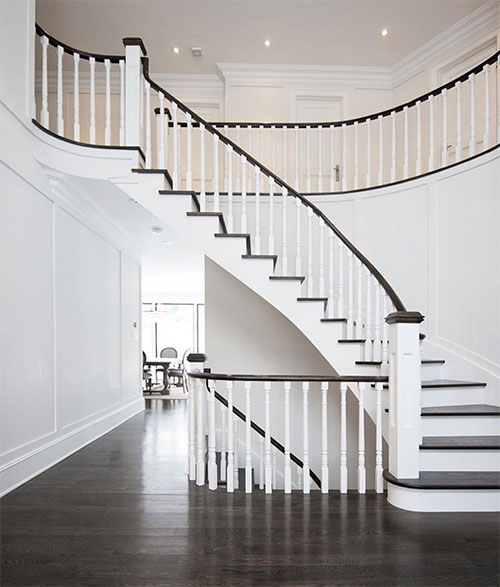
Best Wood Species for Stair Treads
Estate Millwork offers stair treads in many different premium hardwood species that will work for you and also look good. Stairs can see a lot of traffic so when it comes to choosing new wooden stair treads you want something that is not only going to last but look good and tie into your homes overall decor. Let's look at a few of the wood options for stair treads and their benefits.
Red Oak
- Durable
- Easy to stain
- Readily available
- Heavy grain patterns
Hard Maple
- Has a naturally light color
- Can be stained virtually any color
- Durable
- Consistent limited grain pattern
White Oak
- Durable
- Heavy grain patterns
- Popular to stain with "white wash"
Walnut
- Diverse grain pattern
- Beautiful with a clear finish
Frequently Asked Questions
What wood species does Estate Millwork offer?
We offer over a dozen premium hardwood species including Spanish Cedar, Mahogany, White Oak, Red Oak, Cherry, Walnut, Maple, Poplar, Sapele, Teak, Cypress, Western Red Cedar, and Knotty Alder. Each species is kiln-dried and selected for grain quality and structural integrity.
How long does it take to receive a custom order?
Most custom orders ship within approximately four weeks from the date of order. Every piece is built to order in our Pennsylvania workshop using traditional joinery methods, so production time varies slightly based on complexity and current demand.
Does Estate Millwork ship nationwide?
Yes. We ship custom millwork to all 50 states via common carrier. Every order is carefully packaged to prevent damage during transit, and tracking information is provided once your order ships.
Can I get an instant quote online?
Yes. Our online product designers let you configure your custom doors, shutters, or cabinet doors to your exact specifications and receive an instant price quote with no waiting. You can adjust dimensions, wood species, and style options and see the price update in real time.
Expert Tips for Custom Millwork Projects
- Always measure twice before ordering custom millwork. Accurate measurements are the single most important factor in ensuring a perfect fit and avoiding costly returns or modifications.
- Consider the wood species carefully based on where the millwork will be installed. Exterior applications require rot-resistant species like Spanish Cedar, Cypress, or Teak, while interior projects offer more flexibility in species selection.
- If you are unsure about a wood species or style, contact Estate Millwork at 412.641.0177. Our team can recommend options based on your project requirements, climate, and design preferences.
- For painted millwork, Poplar is the best value choice because it takes paint smoothly and machines cleanly. Reserve premium species like Walnut and Cherry for stained or clear-coat applications where the natural grain will be visible.
Build your new Custom Millwork and get a Free Instant Quote Today
Our state of the art designers allow you to design and build completely customized millwork to fit your exact needs.
Questions or concerns contact us contact us or via 412.641.0177 .
Build an Instant QuoteWhy Custom Millwork Makes a Difference
Mass-produced doors, shutters, and cabinets are built to standard dimensions using the fastest possible construction methods. Custom millwork takes the opposite approach: every piece is built to your exact measurements using time-tested joinery techniques that have proven themselves over centuries. The result is a product that fits perfectly, operates smoothly, and lasts for generations rather than years.
Estate Millwork builds every product in our Pennsylvania workshop using traditional mortise-and-tenon joinery. This technique interlocks the rails and stiles with precisely cut joints reinforced by hardwood dowel pins, creating a mechanical bond that does not rely solely on adhesive. Unlike pocket-screwed or biscuit-joined alternatives, mortise-and-tenon joints actually strengthen over time as the wood fibers compress and lock together.
Our manufacturing process begins with hand-selected, kiln-dried lumber graded for architectural appearance. Each board is inspected for grain pattern, color consistency, and structural integrity before entering production. CNC machinery cuts joints to thousandth-of-an-inch tolerances, and skilled woodworkers assemble, sand, and inspect every piece before it ships. This combination of modern precision and traditional craftsmanship is what separates custom millwork from stock alternatives.
Explore our product lines and design something uniquely yours:
Need Help?
Related Posts
Interior Cabinet Door Styles That Elevate Your Kitchen Or Bathroom
Published: November 12, 2025
Why Mortise & Tenon Joinery Still Matters in Millwork
Published: October 23, 2025
From Shaker To Raised Panel: Cabinet Door Styles That Transform Your Home
Published: October 08, 2025
How to Match Door & Shutter Styles for a Cohesive Home Design
Published: September 30, 2025
Choosing the Right Exterior Shutters: Louvered, Board & Batten, Bahama, and More
Published: September 25, 2025
The Warmth Of Wood: Barn Doors Tailored To Your Home
Published: September 09, 2025
Classic Style, Modern Strength: Custom Wooden French Doors
Published: September 03, 2025
Built By Hand, Designed To Last: Custom Wood Louvered Doors
Published: July 07, 2025
Flat Panel Shutters For Colonial, Craftsman, And Farmhouse Styles
Published: May 28, 2025
Bring Old-World Charm Home With Custom Wooden Louvered Shutters
Published: May 04, 2025